

The Power of Starting Small: Why the Compound Effect Rewards Consistency Over Time
Most financial progress, at least from what I have observed, does not begin with dramatic decisions or sudden breakthroughs. It begins with an ordinary choice to set something aside, delay a purchase, or invest a small amount without expecting much in return. On its own, that action feels minor, and it does not change your circumstances overnight. Yet repeated over time, those decisions begin to shape direction. The change is gradual and almost invisible at first, but it is real.
In our previous blogs, we explored how everyday save-or-spend decisions influence long-term outcomes, how small purchases compound just as much as small savings, and how mindset often matters more than income. Building on those ideas, I keep returning to the same conclusion: meaningful financial change rarely starts with something dramatic. It starts with consistency. If you want to understand why small actions matter more than they appear to, read on.
Why Starting Small Feels Insignificant but is Not !
One of the biggest barriers to saving money consistently is emotional, not mathematical. Before we even start thinking about numbers, doubt creeps in: Is this small effort actually making a difference? The question “Is this even worth it?” quietly nags at many of us. That feeling is normal, and it can make even the most disciplined saver feel uncertain about continuing.
Starting small makes progress seem slow. According to Forbes, even small monthly investments can add up significantly over time due to compound growth. For example, investing just $30 each month at a 5 percent return could grow to $25,000 in 30 years. The results feel out of sync with your effort. This early stage can be discouraging because we seek progress in weeks or months, but financial growth is measured in years and decades.
Many people stop here, not because the strategy is flawed but because early results fail to inspire confidence. We underestimate the power of repetition and expect things to happen quickly. When was the last time you abandoned a goal because you didn’t see results? Reflecting on this shows how easy it is to give up when progress is invisible.
The slow start isn’t a flaw; it’s what makes the process work. Real growth comes from sticking with small actions, not chasing quick wins.

Understanding the Compound Effect and the Hockey Stick Curve
The compound effect is what happens when you drop another coin in the jar, day after day, until the jar begins to fill. Each action adds to the pile, and what started as a small clink at the bottom gradually becomes something you can see and feel. Over time, these individual drops build on one another. Results accumulate and begin to generate further results.
In money matters, this is similar to compound interest. Returns create more returns. Growth leads to more growth. What starts as slow progress can eventually look like the hockey stick curve, where things speed up sharply after a long, quiet period.
The key takeaway: acceleration comes later, after steady progress. Patience and ongoing effort are required before significant results show.
In the early years, the graph looks almost flat. It can feel pointless to continue. But if contributions remain consistent, the curve bends upward as time does the heavy lifting.
This is why the compound effect is often misunderstood. People expect visible rewards too soon and assume their effort is not working, even when foundations are forming for later results.
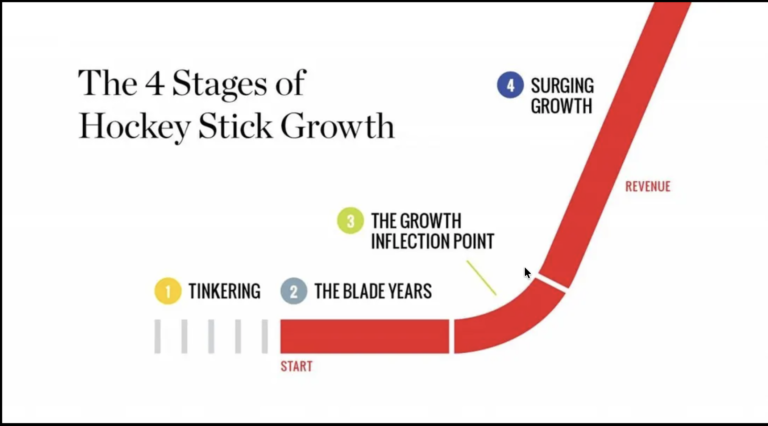
The Hockey Stick Principles, Flatiron Books
What Compound Effect, Atomic Habits, and a Growth Mindset Suggest About Money
Darren Hardy popularised the compound effect. His argument: Small, smart choices, done consistently, make a big difference over time. Small, poor choices do the same. (Hardy, 2010) Therefore, try picking one tiny financial decision you can repeat, like rounding up each payment into savings or skipping one small indulgence a week and stick with it for a month.
What stands out isn’t dramatic results, but the emphasis on behaviour on habits, not outcomes. A similar idea shows up in Atomic Habits by James Clear. The point is that small improvements, sustained over time, change who you are and your long-term results. (Clear, 2018)Instead of focusing only on trying to save more, aim to become a consistent saver, the kind of person for whom saving is simply part of their identity. The change on any single day may be hard to notice. Over the years, it has become important. By focusing on the identity you build through these actions, you reinforce the persistence needed for real progress.
A growth mindset, popularised by Carol Dweck, reinforces this. Believing you can improve with learning and repetition keeps you engaged during slow progress. (Growth Mindset, n.d.) Early results are part of the process, not a verdict.
So, if your first plan or habit feels awkward or yields little change, treat it as practice and commit to refining as you go. The core lesson is clear: sustained, repeated small actions, not fleeting bursts, drive lasting financial success. It is worth celebrating every scheduled transfer or every time you show up for your routine, regardless of your account balance. Each time you make a consistent effort, you reinforce habits that build real change. By commending yourself for sticking to the process rather than waiting to cheer only at the final balance, you keep motivation alive during the quieter phases when results are not yet obvious. Remember that consistency in your routine is the key to achievement. The numbers will follow.
Why Most People Quit Before the Results Show
In my view, quitting early is rarely about numbers. It’s about expectations.
If you expect a small investment to quickly transform your situation, you’ll be disappointed. When saving money must feel exciting, staying motivated is hard after the novelty fades.
The compound effect rewards patience, but patience is uncomfortable. It requires acting today for benefits that may take years to appear.
There is also a comparison. In a world where financial wins are highlighted, slow progress can feel inadequate. Yet those successes often represent the later stages of long-term consistency.
What we rarely see are the early years: the disciplined contributions, the uneventful months, the repeated choice to prioritise future stability over present impulse.
As discussed earlier, daily save-or-spend decisions accumulate. Repeated immediate consumption shapes one path; consistent saving or investing shapes another. No single decision feels monumental, but the gap between paths widens over time.
The widening gap appears slowly; it does not announce itself.

Small, Consistent Financial Actions That Add Up Over Time
To make progress feel achievable, view these financial actions as a ladder, starting with the simplest steps and working your way up. This sequence helps build your momentum and reduces the feeling of having too many options at once.
Here’s a path you can follow, from easiest to most involved:
- Start by setting aside a very small amount each month, even if it feels almost insignificant. This helps you get used to saving without pressure.
- Automate your savings so the process happens without relying on daily willpower.
- As your income increases or expenses decrease, gradually increase your savings. Even small increments matter over time.
- Periodically review your spending to align your habits with financial priorities and adjust your savings plan if needed.
None of these steps is revolutionary. They are deliberately ordinary. The power lies in their repetition.
Their repetition is where the power lies.
Regular saving builds future focus. Small investments offer long-term growth. Gradually changing habits avoids sudden, drastic shifts later.
Outcomes aren’t guaranteed. Strategies differ. Markets shift. Incomes vary. But consistency over time applies broadly.
Starting small lowers psychological barriers. One effective way to do this is by treating your initial contributions as an experiment rather than a permanent commitment. For example, consider a 30-day trial of setting aside a small amount. Framing it as a short-term experiment reduces the fear of mistakes, encourages curiosity, and allows you to learn as you go, making it easier to start and stick with the habit long enough for time to work in your favour.

The compound effect doesn’t demand perfection. It demands persistence.
Over decades, repeated small contributions outweigh ambitious gestures followed by inaction.
Focusing on discipline and consistency reduces pressure. Direction over time, not intensity, brings results.
If you’ve followed our previous discussions, you’ll see the pattern: individual choices seem minor, but together form a trajectory.
The real challenge: Can you sustain small actions long enough for meaningful change? Consistency is the difference-maker.
If this approach resonates, revisit our previous blogs and reflect on how your choices align with your long-term direction. Then, try the Save or Spend Calculator to see how today’s decisions could affect tomorrow.