
Save or Spend Calculator – Compare Spending, Saving, and Investing Over Time
How the Save or Spend Calculator Works
Understanding the Long-Term Impact of Saving vs Spending
The Save or Spend Calculator converts your income into an effective hourly rate and applies compound growth formulas to project long-term outcomes.
First, your net annual income and working schedule are used to calculate your hourly rate by dividing your annual income by your total working hours per year. This allows any expense to be expressed in terms of the work time required to earn it.
Second, the calculator projects what the same amount could become if saved or invested. It applies a standard compound growth formula using the rate of return and time horizon you select.
All results are mathematical projections based solely on the data you enter.
Disclaimer: This tool is provided for educational and informational purposes only. It does not constitute financial, investment, tax, or legal advice. All projections are hypothetical and do not guarantee future performance.
How to Interpret Your Results
Your results highlight three core insights:
1. Work Hours Required
This shows how much of your working life is exchanged for the purchase.
2. Future Value (Saved or Invested)
This estimates what the same amount could grow into over time at your selected rate.
3. Long-Term Difference
This compares spending today with allowing the amount to compound.
The purpose is not to eliminate spending. It is to make the long-term trade-off visible before you decide.
Save vs Spend Example: Redirecting €1,200 Per Year Over 7 Years
Assume the following inputs are entered into the calculator:
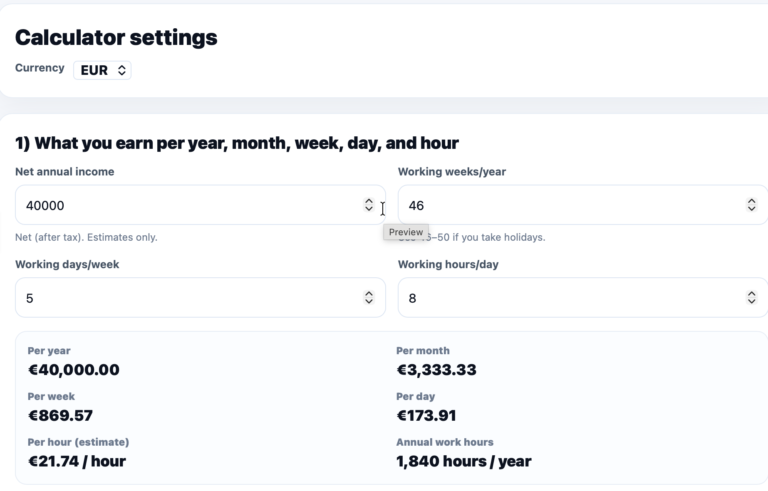
Net annual income: €40,000
Working weeks per year: 46
Working days per week: 5
Working hours per day: 8
Annual non-essential spending: €1,200
Time horizon: 7 years
Save rate: 3%
Invest rate: 7%
1) What You Earn
The calculator first determines your effective hourly rate based on your work schedule.
46 weeks × 5 days × 8 hours = 1,840 working hours per year
€40,000 ÷ 1,840 = €21.74 per hour
This represents the value of one hour of your working time.
2) What Your Non-Essential Spending Costs in Working Hours
In this scenario, the user inputs €1,200 as their annual non-essential spending.
The calculator converts this amount into working time using the calculated hourly rate:
€1,200 ÷ €21.74 ≈ 55.2 working hours per year
This means the €1,200 annual expense represents approximately 55 hours of work each year, or about 1.4 workweeks.
3) What Could Happen If You Saved or Invested That Money Instead
Because €1,200 is treated as a recurring annual amount, the calculator projects what redirecting that €1,200 per year could accumulate over 7 years using compound growth.
If saved at 3% annually, the total accumulated amount would be approximately €9,194.95.
If invested at 7% annually, the total accumulated amount would be approximately €10,384.83.
The difference between saving and investing at these rates over 7 years is approximately €1,189.87.
This comparison highlights both the time cost of spending and the potential long-term impact of consistently redirecting annual expenses into savings or investments instead.
Note: This scenario is for illustrative purposes only and demonstrates how the calculator functions using sample inputs.
What You Earn
Non-Essential Spending Costs in Working Hours and What Could Happen If You Saved or Invested That Money Instead

Why This Comparison Matters
Most financial decisions are not simply about price. They reflect a trade-off between immediate consumption and future financial flexibility.
By converting non-essential spending into working hours and projecting what that money could become over time, the calculator makes opportunity cost tangible. It brings visibility to both the time exchanged and the growth potentially forgone.
The purpose is not to discourage spending. It is to provide clarity, so decisions are made with greater awareness of their long-term impact.
Frequently Asked Questions About the Save or Spend Calculator
1. How is my hourly rate calculated?
Your hourly rate is calculated by dividing your net annual income by your total annual working hours (working weeks × working days × working hours per day).
2. Should I use net or gross income?
Net income is recommended, as it more accurately reflects the amount available to you after tax.
3. Is the annual non-essential spending amount treated as recurring?
Yes. The calculator treats the amount entered as annual recurring spending when projecting future value over the selected time period
4. How are future values calculated?
Future values are calculated using standard compound growth formulas based on the time horizon and the growth rates you select.
5. Does the calculator predict investment returns?
No. Growth rates are hypothetical inputs. The calculator does not predict or guarantee market performance.
6. Does this include inflation?
Inflation is not automatically included. You may adjust the growth rate if you wish to estimate real returns.
7. Can I test different scenarios?
Yes. You can adjust income, spending, time horizon, and growth rates to compare different outcomes.
8. Is this financial advice?
No. The Save or Spend Calculator is an educational tool and does not provide personalised financial advice.